By
Ecential Team
August 25, 2026
•
Updated:
August 25, 2026
•
5 min read


By Jaime Rechkemmer, Aim4Impact Consulting
You know this classroom. There are two teachers on the schedule, but somehow one of them knows everything. She knows Liam didn't sleep last night and will probably fall apart before lunch. She remembers that Ava's extra clothes are in the dryer, notices they're almost out of gloves, redirects the child who was about to bite, answers a parent's question at drop-off, and reminds her co-teacher that the sensory table needs to be sanitized before they switch activities. Her co-teacher is a perfectly nice person who cares about children and, technically speaking, is also there.
And from the hallway, the classroom looks pretty good. Ratios are met. Children are engaged. The room is reasonably organized. Families seem happy, nobody is calling the office every fourteen minutes, and every child goes home wearing approximately the same number of shoes they arrived in. On paper, you've got two functioning teachers and a classroom that's doing just fine.
Except you might actually have one really good teacher quietly doing the work of one-and-three-quarters people.
We don't talk enough about how often our strongest employees make our weakest systems—and sometimes our weakest employees—look better than they really are. That's not just a staffing issue. It's a leadership blind spot, and if we aren't paying attention, the person who eventually pays the biggest price for it may be the very employee we can least afford to lose.
Every child care program has people who naturally fill gaps. They notice things, anticipate needs, remember what everyone else forgets, and don't wait to be asked because by the time someone asks, they've already handled it. We love these people, and we should. They are often the teachers families request, the coworkers everyone wants to work with, and the employees directors trust when the day goes sideways.
The problem is that capable people are so good at compensating that leaders sometimes don't realize how much compensating they're actually doing. The classroom runs, so we assume the team is working. The closing shift gets everything done, so we assume the responsibilities are fairly divided. Families are happy, lesson plans are completed, medication logs are checked, playground bags make it outside, and somehow the room gets reset for tomorrow. We see the outcome and understandably conclude that the system producing it must be working.
But sometimes we aren't measuring the strength of the system at all. We're measuring the strength of the person holding it together.
That's a very different thing.
One of the easiest ways to understand the health of a classroom — or frankly, an entire organization — is to imagine your strongest person disappearing for a week. Nothing terrible has happened. Don't panic. She's simply on a fabulous vacation somewhere with no Wi-Fi and nobody asking her where the construction paper is.
What happens Monday morning?
If the classroom continues to function reasonably well, that's a good sign. Other people know the children's routines, responsibilities are clear, important information is shared, and the work doesn't live entirely inside one person's head. But if her absence suddenly reveals that nobody else knows which family needs a reminder, where supplies are ordered, how the closing routine actually works, or why Mateo absolutely cannot be seated next to Noah at lunch, you just learned something important about your operation.
Our first reaction is often, "See? That's why she's so valuable." And that's true. But good leadership requires us to ask the less comfortable second question: Why did we allow so much of the classroom to depend on one person in the first place?
The employee who always picks up the slack usually doesn't announce it every time she does. That's part of why she's your rockstar. She notices the empty paper towel dispenser and fills it. She sees her co-teacher getting overwhelmed and steps in. She remembers the family conversation nobody wrote down. She fixes small problems before they become director-sized problems, which means leadership may never even know those problems existed.
Until one day, she stops.
Then we're surprised when the dependable teacher becomes frustrated, stops volunteering, asks to transfer, starts calling out, or resigns. We say, "But she seemed so happy here," and she very well may have been. She may have loved the children, the school, her coworkers, and being someone people could depend on. She just didn't love being depended on for everything.
Strong employees can carry an unfair workload for a remarkably long time, especially in early childhood, where helping is practically woven into our professional DNA. But competence shouldn't come with a tax. The reward for being great at your job cannot always be more job.
Eventually, your best people notice when accountability isn't evenly distributed. They notice when the person beside them receives the same praise while contributing much less to the work. They notice when leadership celebrates the classroom's success without understanding who is creating it. And while recognition matters, another "You're such a lifesaver!" isn't particularly comforting when what you really need is for someone else to learn CPR.
This is why leaders have to get close enough to the work to understand how it actually gets done. That doesn't mean micromanaging teachers or standing in the doorway with a clipboard waiting for somebody to make a mistake. It means observing the patterns underneath the outcomes.
Who initiates? Who follows through? Who communicates with families? Who notices the child beginning to struggle before the behavior escalates? Who resets the environment without being asked? Who is constantly reminding another adult what needs to happen next? And perhaps most importantly, who gets to be less effective because someone beside them is so effective?
That last question requires some compassion, too. An employee who isn't contributing equally isn't necessarily lazy, uncaring, or a bad teacher. She may need clearer expectations. She may never have been properly trained. She may lack confidence, struggle with organization, or genuinely believe the division of responsibilities is working just fine because nobody has told her otherwise. Behavior is information, not motivation, and good leaders resist the temptation to assign intent before they understand what's happening.
But compassion doesn't require us to ignore an imbalance. In fact, allowing one employee to continually compensate for another isn't particularly compassionate to either of them. One burns out while the other never gets the coaching she needs to grow.
If you're suddenly picturing one of your classrooms while reading this, resist the urge to rearrange the staffing schedule tomorrow morning. Start by getting curious. Spend a little more time observing how work moves through the classroom. Ask both teachers what they believe they own and compare the answers. Pay attention to who solves problems before those problems reach you, because invisible work is still work even when it never appears on a checklist.
Most importantly, ask your strongest employee a question we don't ask nearly enough: "What are you carrying right now that I may not see?" Then be prepared to actually hear the answer.
You may discover an employee who needs coaching. You may discover responsibilities that were never clearly assigned. You may find a routine that needs a better system, or realize that critical knowledge exists entirely inside one teacher's head. And you may discover that the person you've been calling your "rockstar" doesn't need another compliment nearly as much as she needs some backup.
Great leaders protect their strongest people without turning them into permanent rescuers. They develop the people around them, make invisible work visible, and build systems strong enough that excellence can be shared instead of carried by whoever is most capable of carrying it.
Your best teacher absolutely should make the people around her better. That's one of the wonderful things great educators do.
She just shouldn't have to make them look better than they are.
____________________________________________________________________________
The Problem Is Clear. The Conversation Isn’t.
Of course, noticing that a teacher needs coaching and actually having the coaching conversation are two very different things. It’s easy to rehearse the perfect feedback in your head; it gets considerably harder when the teacher crosses her arms and says, “That’s not what happened,” “Nobody else has a problem with it,” or my personal favorite, “Fine.”
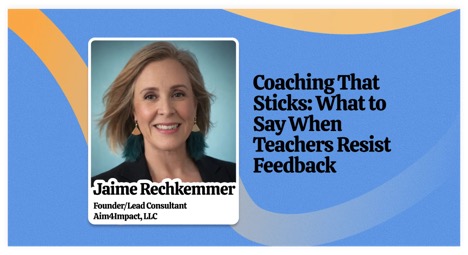
If you’ve ever known exactly what needed to change but struggled with what to say next, join the author Jaime Rechkemmer for Coaching That Sticks: What to Say When Teachers Resist Feedback. We’ll talk about why teachers resist feedback, what that resistance may actually be communicating, and how leaders can respond with both empathy and accountability — without avoiding the hard conversation or turning it into a showdown.
Register and join Jaime August 27 for a practical conversation about making coaching work in real life.